"Go to the far line, sir"

| No Comments | No TrackBacks
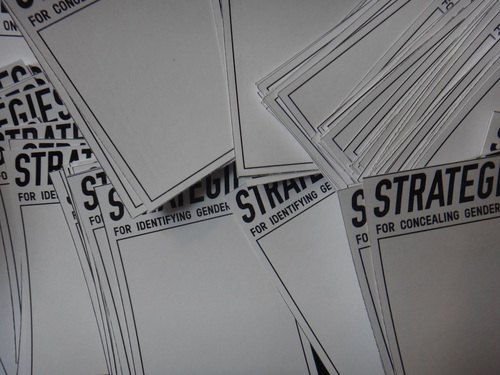
I get called "Sir" a lot in airports, always by people who interact with me for only seconds at a time and who don't have the opportunity to look at my passport. For some reason, it bothers me when I do get called "Sir." Why does it bother me when the agents in airports call me "sir?" It's not that I care deeply what they think of me. It's not that I need them to see me as a woman for any particular reason. It's not that I'm bothered that, on the basis of a glance, they see me as a man. I think what actually bothers me is the embedded presumption that, on a glance, they can assess someone's gender, and pick the right honorific. In the same way that it bothers me when people call me "Mrs. Coons" (the only one of those I know is my grandmother), it bothers me that there's a presumption of fitness to judge, that they think they're qualified to see what I am and respond appropriately. It bothers me that I'm put in the position of either correcting them or ignoring it. Would I be happier if they called me nothing, or called me "hey, you?" Maybe. Maybe I'd like it better if we didn't have a cultural assumption that gender should be clearly and quickly visible. Or that gendered honorifics are polite. Because, of course, it would be considered impolite if they did call me "hey, you." People would probably be affronted by that, and write letters to newspapers about the lack of respect displayed by CBSA employees, or something.

It's a funny extension of the Ma'am/Miss issue. I spend a lot of time irritating ticket agents and people calling from my bank by pointing out that I'm a Ms., not a Mrs. or a Miss. Unless you're looking at my fingers or marital records, it's not transparently obvious whether or not I'm a Mrs. But in the same way that a Mr. doesn't need to disclose that information at every turn, I adopt Ms. in order to not announce to the world my marital status. But we're not at a place yet, as a society, where not disclosing your gender is something you can easily do. Some people may think it's not even possible to not disclose your gender. The moment someone sees my first name, they can have a pretty reasonable assumption that I'm a woman. But without that name, I'm a person with short blue hair, wearing pants, button-down shirts and maybe a blazer, carrying a courier bag and, unless you spend a little time studying my body proportions, apparently pretty androgynous at first glance. All of which makes me a "Sir" for some people. I struggle a lot with whether or not that matters to me.

I'm increasingly coming to the conclusion that my gender and sex aren't actually the business of most people. They matter to me, my doctor, to my partner and presumably to other women using the women's washroom when I am. But do my gender and sex actually matter to the CBSA agent telling me which line to get into at the airport? Not at all. Whether I'm a woman or a man, either in sex or in gender, doesn't impact her at all. There is nothing in our interaction contingent on my gender or sex. This may be why it bothers me that people in such positions presume to guess at which honorific they should use in addressing me. They have no stake in whether I'm a "Sir," a "Ma'am," a "Miss," a "Ms.," or anything else. My gender is not their problem. But they make their assessment of my gender my problem by getting it wrong. Being called "Sir" forces me into an assessment of my comfort with my own androgyny. Luckily, I've had years of practice with that at this point. If I weren't comfortable, it could be crushing. If I didn't adopt the stance that my gender and sex really only matter to very few people, the idea that some people view me at-a-glance as a man could be a problem. Instead, the problem is the presumption of judgement. The problem is that people feel privileged to guess at my gender based on my appearance. The problem is that my brand of androgynous apparently equals male for some people. The problem is that it's considered normal to go through a process of assessing the gender of strangers when we meet them and responding with our assumptions.

Morning crocodile

| No Comments | No TrackBacks
crocodile.png

There's this machine...

| No Comments | No TrackBacks
There's this machine it at the mall. You step into it, some things go buzz for a few seconds, and then you step out. The operator takes your money and gives you a print-out. The print-out has your vital statistics on it: your height (down to the millimeter), your bust, waist, inseam, arm and a whole host of other measurements. In addition to those measurements, the print-out also has a listing of which sizes at which stores are most likely to fit you properly. It's great. No more frustration in the search for perfect jeans. But there's a catch. Maybe you like the style of Zara or H&M, but your body is more of a Reitman's. What do you do? Your body type has been determined, and your perfect matches have been spit out by the infallible, precise machine. You're not an H&M kind of girl. Your chest is too big or your hips too wide. You fit a silhouette with which you don't identify.

We have the technology. We have the supply chain, design and manufacturing capabilities. Being able to know exactly which clothes you belong in and which you don't is a real possibility. And that's supposed to be a good thing, apparently. Companies have been talking for years about the possibility of putting body scanners in malls to measure people exactly and spit out clothing suggestions. But where's the user agency in that?

A model academic

| No Comments | No TrackBacks
I'm proud and I'm ashamed. Once, this past fall, I was a model. And I enjoyed it. Enjoyed being fussed over and ignored. Enjoyed spending five hours getting my hair dyed. Enjoyed getting made up like a porcelain doll, bowing my shoulders, caving my chest in, making faces for the photographer. I enjoyed being, for a time, a completely different person. And I'm some kind of proud that I did it, pleased that I could. Proud that I was chosen, that I was right for it, that my face is now representing something that is completely and utterly not me. Who doesn't want to be told they look good? There's a little ego trip, a little bragging point, in feeling objectively pretty.

But I don't talk about it at school. In that context, I'm just a little ashamed. Or at least a little secretive. It feels strange, in the academic context, to have been a face without a voice, to be employed for how I look instead of what I think. In my academic life, the focus is on what I can produce, not what can be produced using me. And for goodness sake, I do gender. I do body. I do beauty. I do the way we make cultural and functional assumptions about what normal or good should be. I feel a disjoint between what I think, what I write, what I read and what I did that day. I know that there's no such thing as objectively pretty. I know that being a model once isn't a judgement about my value in the world, that my value shouldn't be based on my appearance anyway. Rationally, I know all of this, and I feel strange.

I feel strange because it was great. I did something cool. And I'd do it again. The challenge of embodiment that modelling presented was just plain fun. It reminded me of how I feel when I skate. The concentration on body, on what external effects my smallest actions have, it's always a little bit meditative. Like those maligned and torn-down fourth wave feminists, I wonder if a focus on normative appearance is at odds with my values. I wonder if I'm over-cautious in not talking about the experience. I wonder if that moment actually diminishes me. On the whole, I don't believe it does. Instead of diminishment, I believe it can be viewed as some kind of enrichment. Though I've been treating it as at odds with my academic work, it doesn't need to be. There's no reason that I can't be both object and subject.

PS: To anyone from the "pics or it didn't happen" school of thought, please think before you demand. 

Books on my desk right now - 24 July, 2012

| No Comments | No TrackBacks
In no particular order, here's what I'm reading (or at least have sitting on my desk) right now:

Bowker, G. C., & Star, S. L. (1999). Sorting things out: Classification and its consequences. Cambridge, Mass: MIT Press.

Margolis, J., & Fisher, A. (2002). Unlocking the clubhouse: Women in computing. Cambridge, Mass: MIT Press.

Jepsen, T. C. (2000). My sisters telegraphic: Women in the telegraph office, 1846-1950. Athens: Ohio University Press.

Burger, C. J., Creamer, E. G., & Meszaros, P. S. (2007). Reconfiguring the firewall: Recruiting women to information technology across cultures and continents. Wellesley, Mass: AK Peters.

Foucault, M. (1974). The archaeology of knowledge. London: Tavistock.

Veblen, T., & Chase, S. (1934). The theory of the leisure class: An economic study of institutions. New York: Modern library.

Spradley, J. P., & Mann, B. J. (1974). The cocktail waitress: Woman's work in a man's world. New York: Wiley.

Poggenpohl, S. H., & Satō, K. (2009). Design integrations: Research and collaboration. Chicago: Intellect, the University of Chicago Press.

Boydston, J. (1990). Home and work: Housework, wages, and the ideology of labor in the early republic. New York: Oxford University Press.

Wilson, F. (1991). Sweaters: Gender, class, and workshop-based industry in Mexico. New York: St. Martin's Press.

Stephen, J. A. (2007). Pick one intelligent girl: Employability, domesticity, and the gendering of Canada's welfare state, 1939-1947. Toronto: University of Toronto Press.

Barthes, R. (1983). The fashion system. New York: Hill and Wang.

Brumberg, J. J. (1988). Fasting girls: The emergence of anorexia nervosa as a modern disease. Cambridge, Mass: Harvard University Press.

Gould, S. J. (1996). The mismeasure of man. London: Norton.

Barnes, R., & Eicher, J. B. (1992). Dress and gender: Making and meaning in cultural contexts. New York: Berg.

Thesander, M. (1997). The feminine ideal. London: Reaktion Books.

Wolf, N. (1991). The beauty myth: How images of beauty are used against women. New York: W. Morrow.

Riley, S. (2008). Critical bodies: Representations, identities, and practices of weight and body management. Houndmills, Basingstoke, Hampshire: Palgrave Macmillan.

Welton, D. (1998). Body and flesh: A philosophical reader. Malden, Mass: Blackwell Publishers.

Latzke, A., & Hostetter, H. P. (1968). The wide world of clothing: Economics, social significance, selection. New York: Ronald Press Co.

Krislov, S., & Musolf, L. D. (1964). The politics of regulation: A reader. Boston: Houghton Mifflin.

Doukas, D. (2003). Worked over: The corporate sabotage of an American community. Ithaca: Cornell University Press.

Maines, D. R. (1991). Social organization and social process: Essays in honor of Anselm Strauss. New York: A. de Gruyter.

Christian-Smith, L. K. (1990). Becoming a woman through romance. New York: Routledge.

White, E., Leeds Symposium on Food History, & Leeds Symposium on Food History. (2000). Feeding a city: York : the provision of food from Roman times to the beginning of the twentieth century. Totnes: Prospect Books.

Freidberg, S. E. (2004). French beans and food scares. New York: Oxford University Press.

Anderson, C. (2006). The long tail: Why the future of business is selling less of more. New York: Hyperion.

Braun, R. (1990). Industrialisation and everyday life. Cambridge: Cambridge University Press.

Borges, J. L., & Hurley, A. (1998). Collected fictions. New York, N.Y., U.S.A: Viking.

Bender, D. E. (2004). Sweated work, weak bodies: Anti-sweatshop campaigns and languages of labor. New Brunswick, N.J: Rutgers University Press.

Gamber, W. (1997). The female economy: The millinery and dressmaking trades, 1860-1930. Urbana: University of Illinois Press.

Cochrane, R. C. (1966). Measures for progress. Wash: National Bureau of Standards, U.S. Dept. of Commerce.

Joint Measurement Conference, Boulder Laboratories (U.S.), & American Society for Quality Control. (1972). Proceedings of the 1972 Joint Measurement Conference: June 21-23, 1972. Pittsburgh: Instrument Society of America.

Gandy, O. H. (1993). The panoptic sort: A political economy of personal information. Boulder, Colo: Westview.

Legget, R. F., Economic Council of Canada., & Science Council of Canada. (1971). Standards in Canada. Ottawa: Information Canada.

Dworkin, S. (1987). Miss America, 1945: Bess Myerson's own story. New York, N.Y: Newmarket Press.

DeLuzio, C. (2007). Female adolescence in American scientific thought, 1830-1930. Baltimore: Johns Hopkins University Press.

Cowan, R. S. (1983). More work for mother: The ironies of household technology from the open hearth to the microwave. New York: Basic Books.

Brooks, E. C. (2007). Unraveling the garment industry: Transnational organizing and women's work. Minneapolis: University of Minnesota Press.

Lampland, M., & Star, S. L. (2009). Standards and their stories: How quantifying, classifying, and formalizing practices shape everyday life. Ithaca: Cornell University Press.

Faludi, S. (1991). Backlash: The undeclared war against American women. New York: Crown.

Chapkis, W. (1986). Beauty secrets: Women and the politics of appearance. Boston, MA: South End Press.

Cohen, C. B., Wilk, R. R., & Stoeltje, B. (1996). Beauty queens on the global stage: Gender, contests, and power. New York: Routledge.

Brand, P. Z. (2000). Beauty matters. Bloomington: Indiana University Press.

Lowe, M. A. (2003). Looking good: College women and body image, 1875-1930. Baltimore, Md: Johns Hopkins University Press.

Bermúdez, J. L., Marcel, A. J., & Eilan, N. (1995). The body and the self. Cambridge, Mass: MIT Press.

Brumberg, J. J. (1997). The body project: An intimate history of American girls. New York: Random House.

Bordo, S. (1993). Unbearable weight: Feminism, Western culture, and the body. Berkeley: University of California Press.

Butler, J. (1999). Gender trouble: Femminism and the subversion of identity. London ; New York, N.Y: Routledge.

Finkelstein, J. (2007). The art of self invention: Image and identity in popular visual culture. London: I. B. Tauris.

Blackman, C. (2009). 100 years of menswear. London: Laurence King.

Goffman, E. (1979). Gender advertisements. New York: Harper & Row.

Kidwell, C. B., Christman, M. C. S., National Museum of History and Technology., & Daniel J. Boorstin Collection (Library of Congress). (1974). Suiting everyone: the democratization of clothing in America. Washington: Published for the National Museum of History and Technology by the Smithsonian Institution Press; [for sale by the Supt. of Docs., U.S. Govt. Print. Off..

Heywood, L. (1996). Dedication to hunger: The anorexic aesthetic in modern culture. Berkeley: University of California Press.

Glowering Bruno Latour on a sticky note

| No Comments | No TrackBacks
20110930_045.jpg
Think of this as a daily illustration circa September 30, 2011.

How to wear a bra right

| No Comments | No TrackBacks
Today, a very daring daily illustration that I actually drew a couple months ago. Because I'm being a little slack right now in both drawing and blogging. Based on fitting instructions from a 1950s US government pamphlet on proper bra fit, a lady wearing a bra. I used a version of this illustration on a research poster.

brafitback.png

Localisation/Internationalization

The simple difference between an "s" and a "z" is a small but vital representation of the theme for issue 2.1 of Libre Graphics magazine. While the two letters sound the same when used in words like "localisation" and "internationalization," the cultural baggage attached to them differs. They indicate the way small regional differences are played out, the way choices are made on national and regional levels, for reasons of culture, heritage or simply backlash.

In software, localisation and internationalisation go hand in hand, with internationalisation forming the framework into which localisation is slotted. Creating a piece of software representing a notional no-place allows customisation, serving very real some-places. In technology, art, design and everyday life, we see countless examples of artefacts walking the line between localisation and internationalisation. From the no-place, wordless, pictorial instructions for assembling flat-pack furniture to the clothing hang tag written in six languages, we find different tactics for coping with our small world.

We're looking for work, both visual and textual, exploring issues of regionalisation, localisation, internationalisation and globalisation. Whether it's the cultural differences in the significance of colour, or the unique problems of non-latin type, we want to hear about and see it. We invite submissions for articles, showcases, interviews and anything else you might suggest. Proposals for submissions (no need to send us the completed work right away) can be sent to submissions@libregraphicsmag.com. The deadline for submissions is May 31, 2012.

Localisation/Internationalization is the first issue in volume two of Libre Graphics magazine. Libre Graphics magazine is a print publication devoted to showcasing and promoting work created with Free/Libre Open Source Software. We accept work about or including artistic practices which integrate Free, Libre and Open software, standards, methods and licenses.

Flamingos

| No Comments | No TrackBacks
flamingopair.png

Ordinary bicycle stencil

| No Comments | No TrackBacks
Below, an outline drawing of an ordinary bicycle. I'm going to laser cut it out of card stock and use it as a stencil. It's forming the basis of an article I'm writing about making stencils. Photos once that's all done. ordinary-bicycle.png